Use OMLA-licensed models with confidence
An OMLA License gives you a clean deal, whether you're a two-person shop or a platform serving millions: use the model freely for non-commercial work, and when it makes you money, share 30% of the greater of attributable revenue or run cost with the people who built it. No telemetry, no deployment restrictions, no surprise terms — one royalty rule and a public record.
Two lanes, one rule
Non-commercial — free
Research, coursework, personal projects, hobby experiments, and internal R&D toward future OMLA-licensed models. No registration, no reporting, no royalty.
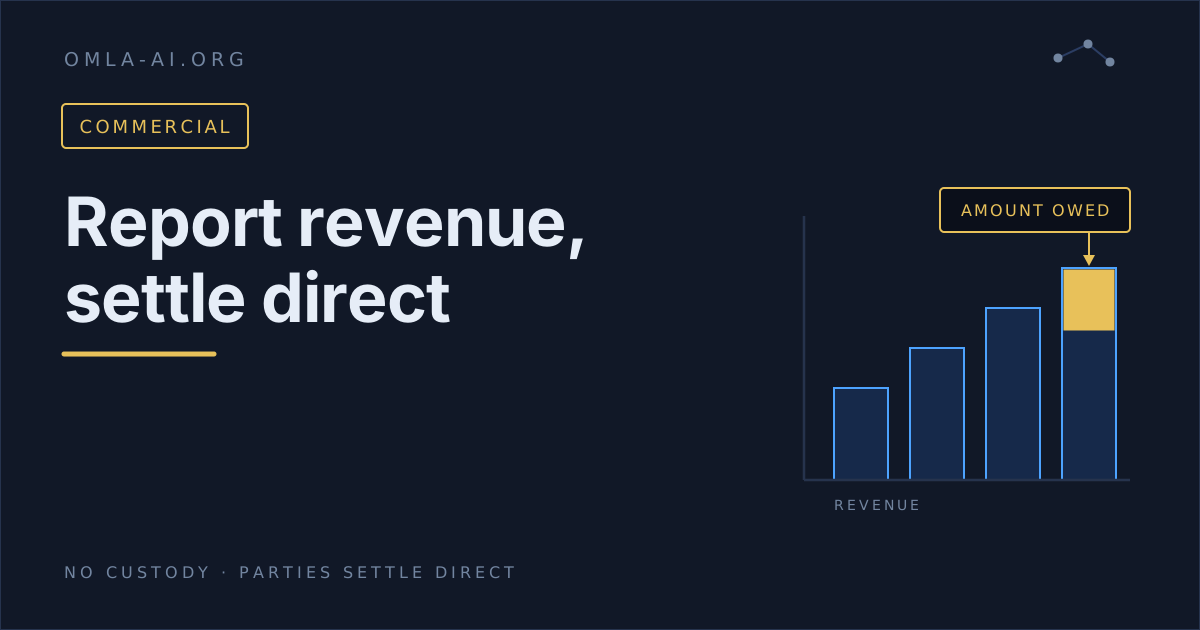
Commercial — 30% to creators
Anything that seeks or produces revenue or material benefit — sales, subscriptions, ads, paid services, or enhancing another product. You owe 30% of the greater of attributable revenue or total run cost, split among the model's creators.
The full definitions live in the Model License §1 and §4, with fifteen worked examples in the FAQ.
Everything runs from three pages
Company registration
One-time setup that links a company record to your account. Name, contact email, country — that's it.
Commercial hub →Quarterly usage report
Declare the OMLA-licensed models you ran, attributable revenue, and compute cost. Either figure can be zero — a truthful $0 quarter is a valid report.
Submit a report →Statements & history
Every published statement with the amount owed and where to send it, plus your past reports. Settle directly, then attest it with a reference.
Report history →If you're small, this was designed to stay out of your way
- The routine is one form a quarter. No audits to schedule, no license negotiations, no per-seat pricing — report what the model earned and what it cost to run.
- Can't attribute revenue precisely? Use cost. The greater-of basis means an honest run-cost figure works when revenue attribution is genuinely murky — a side project that cost $40 to run owes $12, not a forensic accounting exercise.
- Pay the way you already pay. Creators publish their own Stripe, PayPal, Lightning, or bank details; settling can be as simple as three ordinary transfers.
- Slow quarter? Say so. Reports with zero revenue and zero cost are legitimate — they keep your record clean without owing a cent.
- Check your math against the examples. The FAQ walks through fifteen real scenarios — subscriptions, ad-supported apps, resold outputs, internal tooling — with the arithmetic done.
If you're big, the record-keeping was built for your auditors
- Verify before you deploy. Every registered model carries a SHA-256 weight hash — paste yours into the registry verifier and know you're running exactly what was licensed, with its lineage and compliance standing in view.
- Statements are audit-grade. Amounts are computed in exact cents, every statement is versioned with payee details snapshotted at publish time, corrections supersede rather than overwrite, and the whole trail sits on an append-only, hash-chained audit log.
- Settlement fits your AP process. Statements name conventional rails — Stripe, PayPal, ACH, SEPA, Wise, Lightning. Pay through your existing accounts-payable controls and attest each settlement with your own reference.
- Compliance is public and legible. Four states — REGISTERED, COMPLIANT, DELINQUENT, BLACKLISTED — per model, driven by deliberate review rather than automated triggers, with a documented complaint and appeal path.
- No lock-in to price around. The license imposes no telemetry, no deployment-venue restrictions, and no copyleft on your fine-tunes — cloud, on-prem, edge, or air-gapped are all fine.
- Running a marketplace or inference platform? The platform integration guide covers registry lookups and usage reporting at platform scale, and the hosters page states exactly where hosting-provider reimbursement stands in v1.1.
Straight answers about the beta
- Reports are submitted from your signed-in account; automated API credentials are not currently issued — programmatic reporting SDKs are on the roadmap.
- "Quarterly" is the reporting unit, not an enforcement engine — there is no automated due-date tracking today, and compliance transitions are made by deliberate human review.
- Sanctions, KYC, and tax obligations on settlement remain with you and the payee, exactly as they would for any direct payment you make.