How OMLA works
OMLA — the Open Model Licensing Association — is a non-profit registry and royalty-measurement service for open-weight AI models. Models stay free for non-commercial use. When a model earns money, OMLA computes what is owed to its creators, publishes each amount beside the creator's own payment details, and steps out of the way: the parties settle directly.
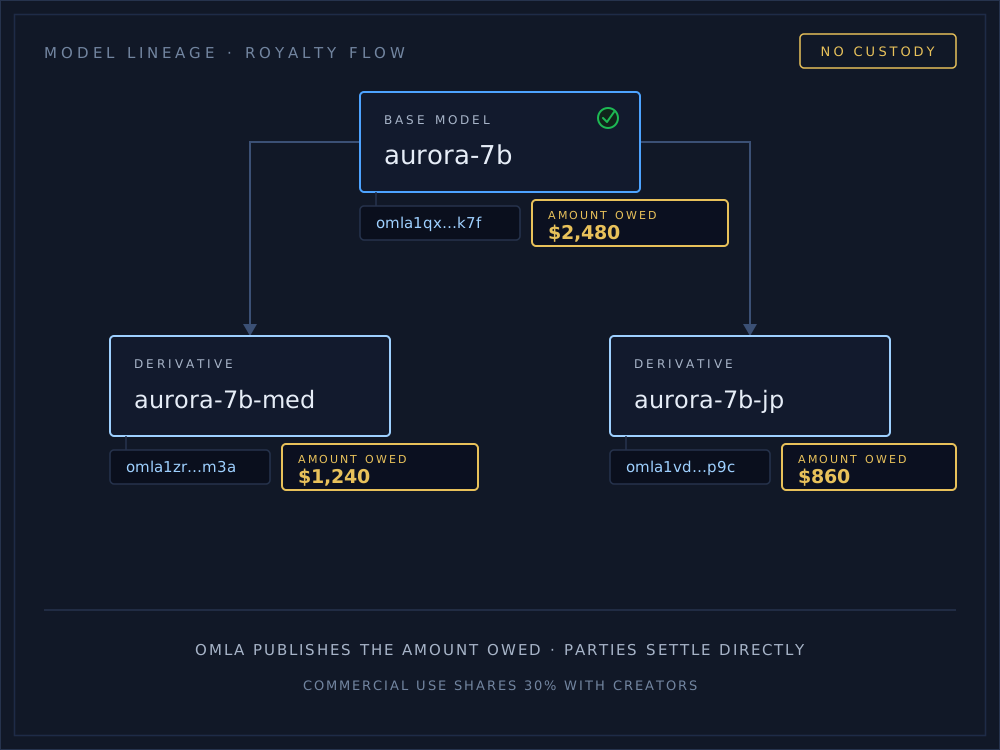
From weights to royalties — the pipeline
-
Publish & sign
A creator registers the model in the browser, signing a message bound to their account, the SHA-256 hash of the weights, and the exact license version they accept. Signing uses Ed25519 today; the verifier and schema are post-quantum-ready (hybrid ML-DSA-65 is on the roadmap).
-
On the record
The model, its metadata, and its declared lineage appear in the public registry. Lineage is a strict parent-child graph — provenance you can inspect, not a marketing claim. Compliance standing starts at REGISTERED.
-
Declare the split
The creator allocates exactly 30 points of the creator pool across the model's own contributors and its direct lineage parents. One explicit table, verified wallets only — no hidden recursion.
-
Verify wallets
Every payee wallet is an
omla1…identifier with a checksum-validated address and a usable payment destination the creator provides — Stripe, PayPal, Lightning, ACH, SEPA, or Wise. A wallet without a real destination cannot be named in a statement. -
Report usage
A commercial user files a usage report per model, per quarter: attributable revenue and total run cost. Either figure may be zero — a truthful $0 quarter is a valid report.
-
Statements published
OMLA computes 30% of the greater of the two figures, in exact cents, and publishes a versioned royalty statement for each payee with their payment details snapshotted in. The other 70% stays with the licensee — OMLA takes no cut of any of it.
-
Settle directly
The commercial user pays each creator at the published details, then attests the settlement with a reference. The attestation is the payer's own record — OMLA never touches, verifies, or executes the transfer.
-
Compliance & audit
A four-state compliance machine — REGISTERED, COMPLIANT, DELINQUENT, BLACKLISTED — records every model's public standing, and every change lands in an append-only, hash-chained audit log that anyone can verify.
What an OMLA License means — and does not mean
An OMLA License, and by extension the OMLA non-profit corporation, does:
- Mean free non‑commercial use (research, personal).
- Mean a royalty payment if used commercially to the creators.
- Base royalties on revenue from the model or cost to run: easy to compute, easy to pay.
- Provide a wallet framework where OMLA publishes the amount owed to all upstream model creators based on proportional contributions, so the commercial user can pay each directly.
The OMLA License, and by extension the OMLA non-profit corporation, does not:
- Force open‑sourcing of derivative code or weights.
- Restrict deployment venue (cloud, on‑prem, edge, offline).
- Mandate specific payment rails or wallets.
- Track usage via telemetry or invasive reporting.
- Impose copyleft/viral obligations (except the commercial use royalty stipulation for upstream models).
Four lanes, one registry
Creators
Publish your model, declare your split, and get paid directly for commercial use.
Users
Free for non-commercial work; a clear quarterly routine when a model earns money.
Hosters
Where hosting providers stand in v1.1, and what reimbursement will take.
Platforms
Integration surfaces for marketplaces, routers, and inference providers.
Built in the open
OMLA is in public beta. The registry, licensing, reporting, and compliance machinery described above is built and staged; the roadmap tracks what is live, what is pending, and what still needs decisions — including the items below.
License and Framework Development (click to expand)
Projected timeline and features to build. Full status on the roadmap page. If you're interested in helping, reach out.
- Wallet architecture (Bech32m
omla1…addresses) — completed Aug 2025 - Hosted database with registry, lineage, splits, royalty statements, audit log — completed Sep 2025
- Model registration: Ed25519 identity + SHA-256 weight hash + signing — completed Sep 2025
- Public registry with searchable model cards and detail pages — completed Oct 2025
- Creator dashboard: models, wallets, earnings — completed Mar 2026
- Commercial-user flow: company registration, quarterly usage report, history — completed Apr 2026
- Compliance state machine + complaint intake — completed Apr 2026
- Payee-chosen payment-method display (creators publish their own Stripe, PayPal, Lightning, or bank details; OMLA only displays them and operates no rails) — in progress
- Proof-of-concept settlement cycle (OMLA publishes the amount owed and payee wallet; parties settle directly — first quarter with real creators) — pending
- Open-source SDKs for model card invocation + usage reporting — pending
- Royalty-tracking embed for common inference gateways — pending
- Donation / sponsor methods and transparency reports — pending
- US EIN, bank account, and 501(c) filing — pending
- Founding board established — completed 2025
- Outreach to larger model makers & distribution platforms — ongoing
- Heads of compliance for major jurisdictions — pending
- Fundraising + government grant applications — ongoing
- Translations of license and site into common languages — pending
- Extension: likenesses, art, and other creative-work licensing — pending
- Community forum + feedback channels — pending
- End-user usability review & accessibility audit — ongoing
Framework under active development. Regulatory approvals may extend beyond submission dates.
Questions, specifications, and the fine print
Docs
Schema, wallet protocol, compliance states, and integration guides for builders.
Open the docs →License
The operative Model License & Royalty Terms, v1.1 — the one rule, in full.
Read the License →