OMLA Model License & Royalty Terms Version 1.1
Operative agreement · Version 1.1 — Effective 2026-07-13 · Last updated 2026-07-13
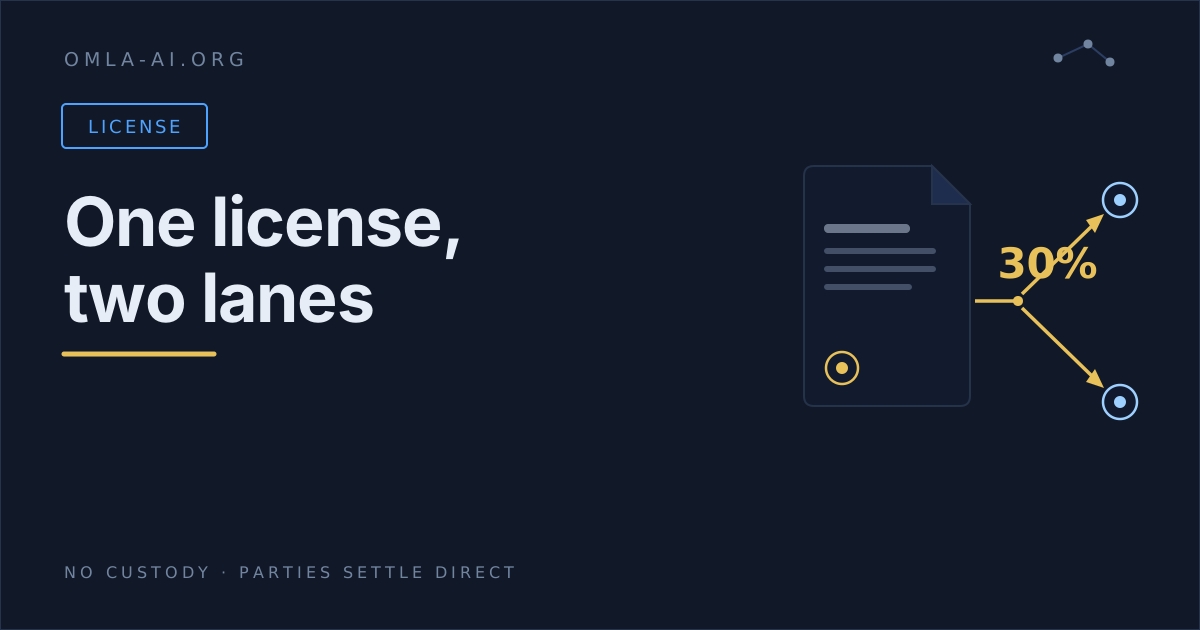
Unlimited personal and research use. Commercial use is permitted under one royalty rule: pay the greater of (i) 30% of attributable revenue or (ii) 30% of total model run cost. The Open Model Licensing Association ("OMLA") never holds or moves any money — it computes the amount owed and publishes the payee's self-provided wallet, and the commercial user pays the creator directly.
Translations are provided for convenience; the English version governs.
No custody. No money transmission.
OMLA computes amounts owed under this License and publishes the payee's self-provided wallet or payment method. OMLA never receives, holds, escrows, routes, converts, refunds, or transmits any payment, and is not a party to, intermediary of, beneficiary of, or guarantor of any settlement. Commercial users pay creators directly. OMLA is not a money transmitter, money-services business, payment processor, bank, exchange, custodian, escrow agent, broker-dealer, or investment vehicle or adviser. There is no "OMLA balance." Royalty statements are computed notices of amounts owed, not invoices that OMLA collects. Wallet identifiers (including omla1… addresses) are routing identifiers, not accounts that OMLA holds or that hold value on OMLA's behalf. Nothing on this site is financial, investment, tax, or legal advice, or an offer of securities.
OMLA Model License & Royalty Terms — Version 1.1 (operative, binding)
Quick summary
| Area | Rule |
|---|---|
| Non-Commercial | Free for academic, research, personal, and internal R&D use (including development of future OMLA-licensed models). |
| Commercial | Pay 30% of attributable revenue or 30% of total model run cost — whichever is greater. |
| Splits & lineage | Each Model has one declared creator-pool split totaling 30 points. That table is the sole payment allocation; lineage is provenance and is not recursively traversed. |
| Statements & payment | OMLA publishes a royalty statement (amount owed + each payee's self-provided wallet). The commercial user pays each payee directly. OMLA never holds or moves funds. |
| Hoster configuration | Version 1.1 activates no non-zero hoster allocation. A non-zero hoster setting blocks statement publication until an operative payee path is introduced by a later License version. |
| Reporting | Commercial users file a quarterly usage report; OMLA issues a statement; compliance advances. |
| Complaints | Anyone may email a complaint record for manual review. Filing alone does not change registry status or statement publication; the public blacklist feed is disabled. |
| Minimum | A statement set is published only when every positive payee line is at least US$0.10. OMLA v1.1 has no carry-forward ledger and fails closed instead of dropping or accumulating a smaller line. |
| Scope | Global; applies only to commercial use; OMLA disclaims liability and custodies nothing. |
0. Acceptance & binding clickwrap
- This is an operative, binding agreement — not a draft. This is Version 1.1 of the OMLA Model License & Royalty Terms (the "License"), effective 2026-07-13. The version label identifies the operative text; it does not make the License provisional.
- Creator acceptance (clickwrap). A creator accepts this License as a binding clickwrap agreement at model registration by checking the "I agree" box and signing the canonical registration message with their key (see §9). Protocol v4 binds the accepting account, exact License version, SHA-256 digest of the English License artifact, model-weight digest, and exact timestamp. OMLA stores those fields in an append-only acceptance record linked to the registered Model.
- Commercial-user acceptance. A commercial user (the "Licensee" or "payer") accepts this License by making any Commercial Use of a registered Model. Continued Commercial Use constitutes ongoing acceptance of the version in force at the time of that use.
- Relationship to other OMLA terms. This License governs registered Models and the royalty obligation. It operates alongside, and is incorporated into, the OMLA Terms of Service and Privacy Policy. The platform source code is separately licensed under Apache-2.0 (see the project
NOTICE); this License does not govern that source code.
1. Definitions
- Model: the AI model (weights/parameters) licensed here. Derivative Model: any model that incorporates, fine-tunes, distills, or is otherwise based on the Model.
- Creator / Payee: a party entitled to a share of the royalty under a Model's declared split, identified by a self-provided wallet or payment method.
- Licensee / Commercial user / Payer: any party making Commercial Use of the Model and therefore owing the royalty.
- Commercial Use: any use for monetary gain or advantage — hosted APIs, products, internal operations yielding benefit, selling outputs, advertising-supported services, fundraising, sponsorships, or enhancing another product or service.
- Non-Commercial Use: personal, educational, academic, and internal research/R&D use, including internal development of new models intended for future OMLA licensing, where no externalized product or service is offered or sold.
- Total model run cost: the reasonable accounting cost to run and serve the Model (pro-rated cloud/compute, storage, bandwidth, depreciation of dedicated hardware, and direct IT support). If hardware is fully depreciated, there is no support cost, and there is no attributable revenue, the base can be US$0.
- Lineage / Upstream: the directed acyclic graph (DAG) of Models a registered Model is built upon, as declared at registration. Lineage records provenance; it does not itself create a payment share or cause recursive allocation.
- Declared Creator-Pool Split: the single, explicit table attached to a Model that totals 30 percentage points and allocates 100% of that Model's 30% creator pool among verified payee wallets. It is the sole authoritative payment allocation for that Model.
- Royalty Statement ("Statement"): a computed notice OMLA publishes that lists, for a reporting period, the amount owed to each Payee and that Payee's self-provided wallet or method. A Statement is informational; it is not an invoice OMLA collects and creates no "OMLA balance."
- Hoster: a party that hosts or serves a Model. Version 1.1 records hoster information but activates no non-zero hoster payment allocation (see §6).
- Non-payable wallet: an address or account that cannot accept funds — invalid, frozen, sanctioned, an unsupported rail, under an AML hold, under a Creator-requested hold, or technically impossible to pay.
2. Grant & scope of license
- Non-Commercial grant. Subject to this License, each Creator grants a perpetual, worldwide, royalty-free, non-exclusive right to use, modify, and distribute the Model and Derivative Models for Non-Commercial Use.
- Non-commercial research. Research is free where results are not offered or sold and no externalized product or service is created from them.
- Commercial grant. Commercial Use of the Model and its Derivative Models is permitted only on the condition that the Licensee complies with §§3–8 — chiefly the 30% royalty (§4), the statement-and-direct-settlement mechanism (§5), and the quarterly reporting duty (§7). The commercial grant is conditioned on, and automatically suspended by, material non-compliance until cured.
- Scope limits. This License governs only the royalty obligation for Commercial Use of registered Models. It conveys no trademark, patent, or publicity rights beyond those strictly necessary to exercise the grant, and it does not transfer ownership of the Model, your code, your fine-tunes, or your business.
3. Declared creator-pool split & lineage
- Each registered Model's public page displays the License version, model identity and signature status, declared upstream lineage, compliance state, and complaint contact. Payee wallets and the Declared Creator-Pool Split are private registry data and are disclosed to the responsible payer in the immutable Royalty Statement when a payable report is published.
- One-pass explicit allocation. The Declared Creator-Pool Split attached to the reported Model is the only table used to allocate that Model's creator pool. Processing makes one pass over that table and does not recursively traverse the lineage DAG. A derivative Creator who promises a share to an upstream Creator must include that upstream Creator's verified wallet explicitly in the derivative Model's split.
- Accuracy is the Creator's representation. Lineage and splits are declared by, and are the responsibility of, the registering Creator (see §9). OMLA records these declarations; it does not adjudicate or guarantee them.
4. Part A — the 30% commercial royalty
- The rule. Any Commercial Use of the Model requires payment of a royalty equal to the greater of (i) 30% of attributable revenue or (ii) 30% of total model run cost. This 30% is the "creator pool" and is distributed under the reported Model's Declared Creator-Pool Split (§3) and Statement mechanism (§5).
- Pipelines & splits. In composite or pipeline systems, the royalty base is split across the Models used by their declared contribution percentages. Free or non-royalty components reduce the base accordingly. Avoid de minimis attribution where this Model is gating or determinative of the system's output.
- Cost basis. Where revenue cannot be directly attributed (for example, a local or offline service with no tickets), compute the base from accounting cost (such as hardware depreciation and direct support). If hardware is fully depreciated, there is no support cost, and there is no attributable revenue, the base can be US$0.
- No OMLA fee on the royalty. OMLA charges no commission, spread, or fee on the royalty and skims nothing from it. Routing, conversion, or transfer costs of an actual payment are the settling parties' own and are borne between payer and payee; OMLA caps nothing it does not operate.
5. Part B — royalty statements & direct peer-to-peer settlement (no custody)
- OMLA publishes; OMLA does not pay. For each reporting period, OMLA computes each Payee's share of the 30% creator pool from the reported Model's Declared Creator-Pool Split and publishes a Royalty Statement listing the amount owed and that Payee's self-provided wallet or payment method. The Licensee pays each Payee directly. OMLA never receives, holds, escrows, routes, converts, refunds, or transmits any of these funds, is not a party to the settlement, and has no claim to or beneficial interest in it. See the No custody block above.
- Payee-specified method. Each Payee must provide the exact payment method used for direct settlement. OMLA keeps those coordinates private from the general registry and snapshots them into the payer-visible Statement. The Licensee must use the stated method where able. Payment-rail choice and any routing or conversion fees belong entirely to the settling parties — not to OMLA.
- Cadence & minimum. Statements and settlement run quarterly. A complete statement set is published only if every positive payee line is at least US$0.10. Version 1.1 implements no cross-quarter accrual or carry-forward ledger: if any declared positive share is below that threshold, OMLA publishes no statement for the report and requires manual correction or resolution rather than silently dropping the share.
- Non-payable wallets. A Payee must keep its published payment details accurate and usable. If a method cannot receive direct settlement, the parties should document the issue and the Payee should provide corrected information. OMLA does not hold the amount or automatically rewrite an existing Statement.
- No OMLA balance; no OMLA refunds. Because OMLA never receives funds, there is no "OMLA balance," OMLA issues no refunds, and a Statement is a computed notice of an amount owed — never an invoice OMLA collects or a debt owed to OMLA.
6. Hoster configuration status
- Version 1.1 does not activate a non-zero hoster allocation or represent that a hoster will receive a Statement line. The registry may retain hoster metadata and a reserved 0–20% configuration field for future versions.
- If a Model has a non-zero hoster setting, processing fails closed and publishes no creator or hoster Statement. A hoster allocation becomes operative only after a later License version and matching backend add a verified hoster payee destination and end-to-end statement path. OMLA never custodies or routes a hoster payment.
7. Quarterly usage reporting duty
- Duty to report. Each commercial Licensee must file a truthful quarterly usage report for its Commercial Use of the Model, sufficient for OMLA to compute the royalty base (attributable revenue and/or run cost) and the resulting Statement.
- From report to statement. A submitted usage report is processed through OMLA's admin-gated, idempotent statement pipeline, which publishes the Royalty Statement (amount owed + payee wallets) and advances the Licensee's compliance state (§8). The Statement is a computation of amounts owed; it is not a charge by OMLA.
- Records. Licensees must keep reasonable records supporting their reports and make them available to substantiate a Statement in the event of a complaint or audit (§8).
8. Complaints, enforcement & compliance states
- Who may complain. Anyone may file a complaint (for example, about a wallet, a split, lineage accuracy, or non-payment). OMLA does not host or remove Model files and does not adjudicate IP ownership. Private data is retained as described in the Privacy Policy and released only under lawful process.
- Notice & response. Complaints are reviewed manually. OMLA may notify affected parties and request documentation, but does not currently promise a fixed response time. Any registry action is recorded separately.
- No automatic suspension. Filing a complaint does not automatically change a published Statement or registry state. Any correction requires a separate implemented and audited reviewer action. OMLA does not hold, refund, or redistribute funds at any stage because OMLA never receives them.
- Compliance state machine. A Model registration moves through states: REGISTERED → COMPLIANT or DELINQUENT → BLACKLISTED. Timely reporting and Statement resolution keep a party COMPLIANT; missed reporting or willful non-payment may mark it DELINQUENT; sustained misuse, abuse, or willful non-payment may lead to a BLACKLISTED registry status. No funds are seized, held, or held back by OMLA at any state — consequences are limited to registry status and listing.
- Public status only. BLACKLISTED is a registry compliance state. The separate public blacklist feed is disabled and must not be used for enforcement or reputation decisions.
9. Creator representations & warranties
- Right to license. By registering a Model, the Creator represents and warrants that it owns or is authorized to license the Model under these terms, and that doing so does not violate any law or third-party right.
- Lineage & splits are accurate. The Creator represents that the declared lineage DAG is accurate provenance and that the separate Declared Creator-Pool Split is accurate, complete, totals 30 points, and explicitly names every Payee promised a share. The Creator understands that lineage is not recursively converted into payment shares.
- Key & signature. The Creator signs its registration with a post-quantum-capable key — Ed25519 and/or ML-DSA — and represents that the signing key is theirs and under its sole control. The Creator is solely responsible for the secrecy and custody of its secret key. A
signature_verifiedflag is set by OMLA's registration function as a record that a valid signature was presented; it is a representation by the Creator, not an OMLA guarantee of rights or lineage. - Payee details. The Creator represents that the wallet or payment method it provides is its own and is correct, and that publishing it for direct settlement is authorized. OMLA publishes these details as provided and does not verify their commercial fitness.
- Indemnity. The Creator will indemnify and hold harmless OMLA and its directors, officers, volunteers, and contributors against claims arising from the Creator's breach of these representations, including false lineage or split declarations and unauthorized licensing.
10. Outputs
- Monetizing outputs generated with the Model constitutes Commercial Use and triggers Part A (the 30% royalty). This License does not apply or transfer to the outputs themselves; it governs only the royalty obligation arising from the commercial use that produced or monetized them.
11. Disclaimers & no financial services
- As-is. THE MODEL AND THIS LICENSE ARE PROVIDED "AS IS" AND "AS AVAILABLE," WITHOUT WARRANTY OF ANY KIND. OMLA AND CREATORS DISCLAIM ALL WARRANTIES TO THE MAXIMUM EXTENT PERMITTED BY LAW, INCLUDING ANY WARRANTY THAT SPLITS, SIGNATURES, LINEAGE, STATEMENTS, OR THIRD-PARTY SOLVENCY ARE ACCURATE, AND ANY GUARANTEE THAT ANY PAYEE WILL BE PAID OR WILL PAY.
- No financial services. Consistent with the No custody block above, OMLA is not a money transmitter, money-services business, payment processor, bank, exchange, custodian, escrow agent, broker-dealer, or investment vehicle or adviser; it never holds, moves, routes, converts, refunds, or escrows funds; it is not a party to or beneficiary of any settlement; there is no "OMLA balance"; and wallet identifiers are routing identifiers, not accounts that hold value on OMLA's behalf. Nothing here is financial, investment, tax, or legal advice, or an offer of securities.
- Limitation of liability. To the maximum extent permitted by law, OMLA is not liable for indirect, incidental, special, consequential, or exemplary damages, or for lost profits, lost royalties, or unpaid or misdirected settlements between the parties. Because OMLA charges no fee on royalties and custodies nothing, any aggregate liability is limited to the fees (if any) actually paid by the claimant to OMLA in the prior twelve months, which is typically US$0. Some jurisdictions do not allow certain exclusions; those carve-outs apply where required.
12. Term & termination
- Term. This License applies from acceptance (§0) until terminated.
- Termination by a Creator. A Creator may withdraw a Model from future commercial licensing prospectively; withdrawal does not retroactively excuse royalties already accrued from prior Commercial Use and does not delete registry/audit records needed to preserve declared payee obligations.
- Termination / suspension by OMLA. OMLA may suspend a registration's COMPLIANT status, mark it DELINQUENT, or BLACKLIST it under §8 for misuse, abuse, false declarations, or willful non-payment. These are registry consequences only; OMLA seizes or withholds no funds.
- Survival. Sections 4–5 (accrued royalty and settlement obligations between parties), 8 (compliance records and blacklist), 9 (representations/indemnity), 11 (disclaimers), 13 (governing law/disputes), and 14 (general terms) survive termination. Registry and audit records may be retained to preserve lineage integrity and declared payee obligations.
13. Governing law & dispute resolution
- Governing law. This License is governed by the laws of the State of Washington, USA, without regard to its conflict-of-laws rules, except where mandatory local law of a user's home jurisdiction applies and cannot be waived.
- Binding arbitration. Except as carved out below, any dispute arising out of or relating to this License is resolved by binding individual arbitration administered under the AAA Consumer Arbitration Rules, seated in the State of Washington. Judgment on the award may be entered in any court of competent jurisdiction.
- Class-action & jury waiver. Disputes are brought only in an individual capacity; the parties waive any class, collective, or representative proceeding and any jury trial, to the extent permitted by law.
- Small-claims carve-out. Either party may bring an individual claim in small-claims court instead of arbitration if it qualifies.
- EU / EEA / UK mandatory rights. Nothing in this section waives mandatory consumer protections that cannot be waived under the law of an EU/EEA or UK user's home country. Where pre-dispute arbitration or class-action waivers are unenforceable for such users, those users retain their non-waivable statutory rights and may bring proceedings in, and rely on the law of, their local courts.
- Informal resolution first. Before commencing arbitration, a party should contact legal@omla-ai.org and allow a good-faith period of at least 30 days to resolve the matter informally.
14. Versions, changes & general terms
- Operative version. This text is Version 1.1, effective 2026-07-13. It is operative and binding, not a draft. Version 1.0 remains the historical text for Models that validly accepted it; OMLA does not infer or backfill acceptance where no versioned evidence exists.
- Changes are not retroactive. OMLA may publish later versions. A Creator may adopt a later version for its Model, but version changes are not retroactive to Commercial Use already governed by an accepted version, and do not apply to a Creator who has not adopted them.
- Severability & global effect. This License is intended to be globally enforceable. If any clause is unenforceable in a jurisdiction, it is interpreted as closely as possible to its intent, and the remainder survives.
- Entire agreement; assignment; waiver; notices. This License, together with the OMLA Terms of Service and Privacy Policy, is the entire agreement on its subject matter. A Licensee or Creator may not assign it without consent except by operation of law; OMLA may assign it to a successor of its mission. No waiver is implied from a failure to enforce. Notices to OMLA go to the contacts in §15.
- English controls. Translations of this License are provided for convenience only. In the event of any conflict or ambiguity between the English version and a translation, the English version governs, except where applicable mandatory local law requires otherwise.
15. Contact
General: hello@omla-ai.org · Legal & DMCA: legal@omla-ai.org · IP/DMCA notices: dmca@omla-ai.org · Privacy & data protection: privacy@omla-ai.org.
OMLA is the Open Model Licensing Association, an open, community-governed initiative organizing as a nonprofit in the State of Washington, USA; 501(c)(3) status is pending and not yet granted. OMLA is not an incorporated bank or money-services business.
Version 1.1 — Effective 2026-07-13 · Last updated 2026-07-13 (bound versioned acceptance evidence; made the explicit 30-point split authoritative; clarified private payee disclosure, non-recursive lineage, fail-closed minimum handling, and inactive hoster allocation). Translations are provided for convenience; the English version governs.
How to invoke this license on your model page
License: OMLA Model License & Royalty Terms v1.1 (Effective 2026-07-13)
Commercial-use royalty: pay the greater of 30% of attributable revenue
  or 30% of total model run cost.
No cost for non-commercial use.

Payment: OMLA publishes a quarterly royalty statement (amount owed +
  each payee's self-provided wallet). You pay each payee DIRECTLY.
  OMLA never holds, routes, or escrows funds.

Payee wallet: omla1qq...   (a routing identifier you control, per the
  declared contribution-split table; OMLA does not custody it)